✦ Lead Generation Sites
Websites Built to Generate Leads
Programmatic local-SEO properties that rank for hundreds of service-and-city searches at once, then turn that traffic into qualified leads in your inbox or CRM.
Capabilities
What goes into a lead generation build
Six systems working together — from the content engine to the moment a lead lands in your CRM.
Programmatic Page Generation
One structured data layer generates a page for every city and service combination — hubs, combos, and answer guides — so a build ships hundreds of targeted pages instead of a dozen.
Genuine Local Research
Every location carries real detail: waterways, neighborhoods, landmarks, and local conditions. That’s what makes each page substantively different rather than the same paragraph with the city name swapped.
Schema & Technical SEO
Organization, Service, FAQPage, BreadcrumbList, and Article JSON-LD generated per page, plus sitemap and robots built from the same data — so new pages are crawlable the moment they exist.
AEO Answer Guides
Dedicated question-and-answer pages structured for featured snippets, People Also Ask, and AI assistants — capturing the research searches that happen long before someone is ready to call.
Lead Capture & Routing
Forms wired to email, webhook, or straight into your CRM via Zapier or Make. Delivery is verified before launch, and the system never reports a lead it didn’t actually send.
Tracking From Day One
GA4, Google Tag Manager, Microsoft Clarity, and Meta Pixel wired in at build time, so you can see which cities and services actually produce leads instead of guessing.
Case Study
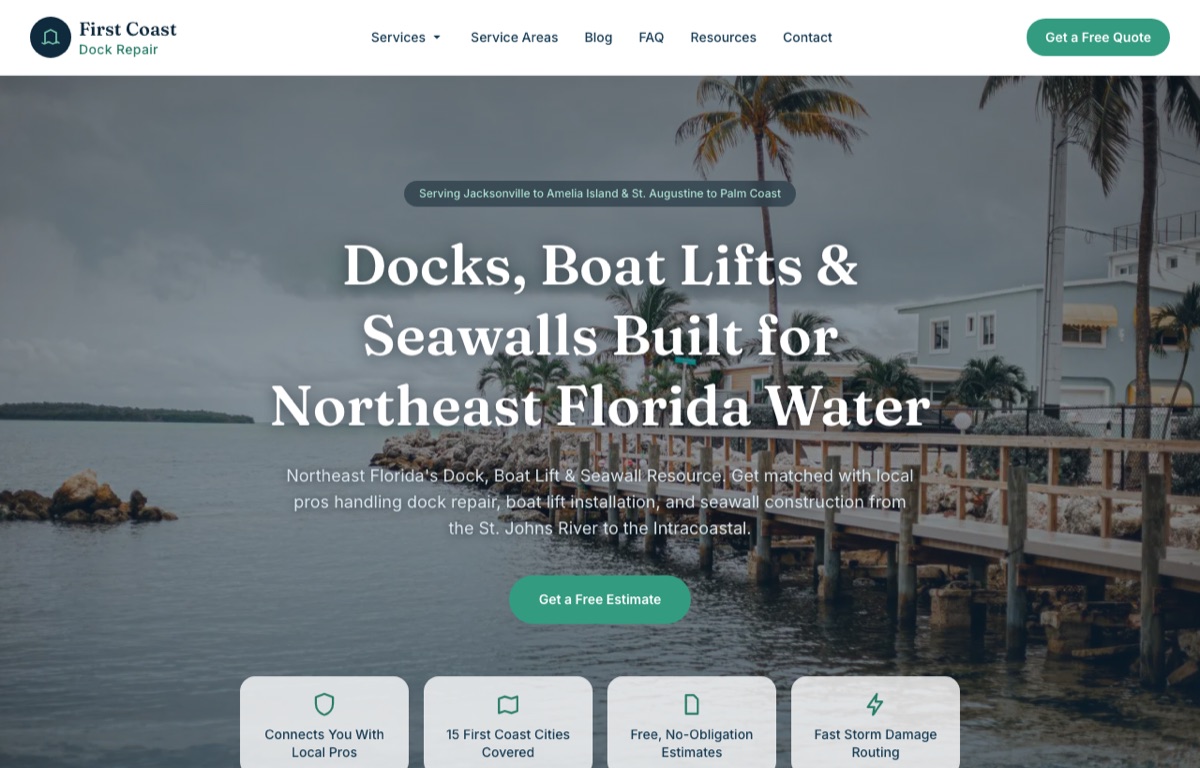
First Coast Dock Repair
A live lead-generation property covering dock, boat lift, and seawall services across Northeast Florida.
What it targets
15 Northeast Florida cities across 21 marine construction services — roughly 170 generated pages spanning service hubs, city hubs, service-in-city combinations, and answer guides. Every page carries its own schema and sitemap entry.
How it stays credible
Each city page is grounded in that city’s actual waterways and neighborhoods, so a page about the St. Johns River reads nothing like one about the Intracoastal. No fabricated reviews, and clear disclosure that it connects homeowners with independent local pros rather than performing the work itself.
Case Study
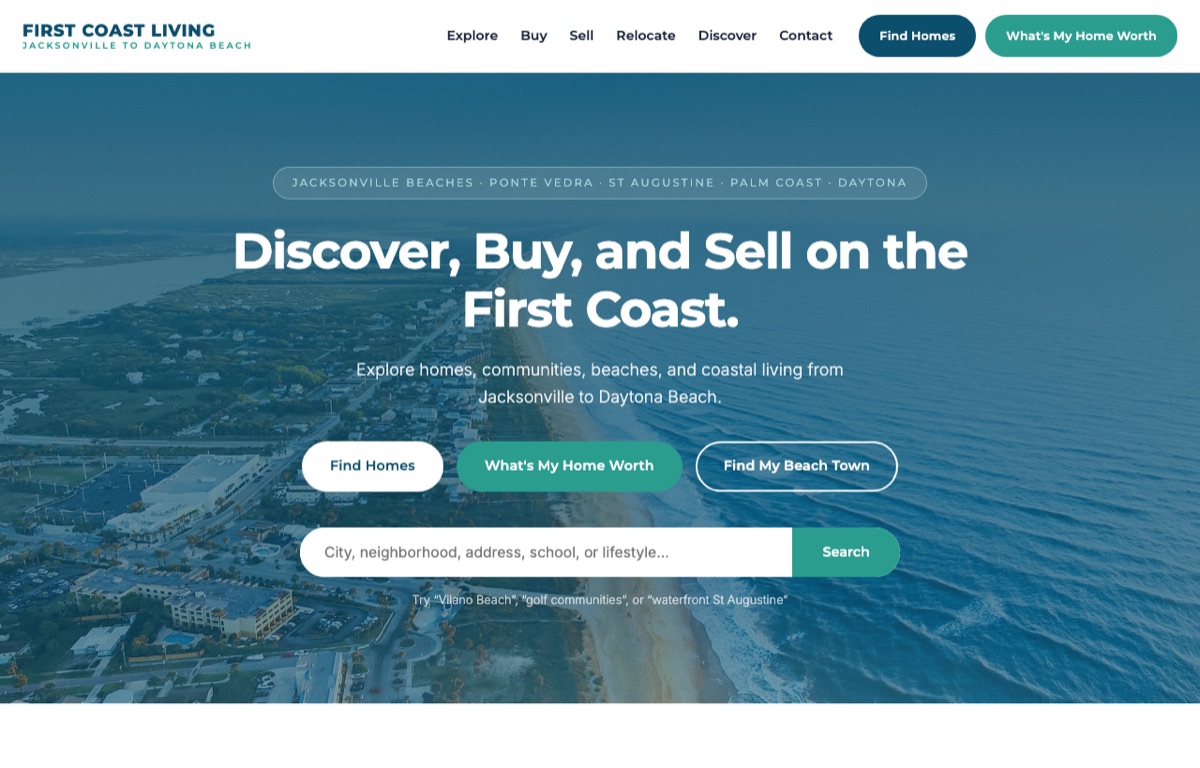
First Coast Living
Real estate lead generation across the Northeast Florida coast — from Jacksonville Beaches to New Smyrna Beach.
Built for a different buyer
Real estate leads arrive months before a transaction, so the site is built around research intent rather than urgency: neighborhood pages, relocation and buyer guides, and beach-town comparisons that earn the visit early — then capture the contact through home valuation and property search rather than a quote form.
Coastal coverage with real data
39 indexed pages spanning St Johns, Flagler, and Volusia counties, with three distinct conversion paths — find homes, home valuation, and a beach-town matcher. A RentCast integration runs server-side through a Netlify function, and an llms.txt file gives AI assistants a clean, citable summary of the service area.
Most local sites compete for the wrong searches
A typical service business site has a home page, a services page, and a contact page. It competes for a handful of broad, brutally contested keywords — and loses to whoever has been building links the longest. Meanwhile the searches that actually convert are long, specific, and local: a particular service, in a particular town, with a particular problem attached.
There are usually hundreds of those searches in a given market, each with modest volume and far less competition. No one hand-writes hundreds of pages. So we build the system that does — a structured content model where services, locations, and local research are data, and every viable combination becomes its own page with its own copy, schema, internal links, and sitemap entry.
What actually gets built
- Service hubs — one authoritative page per service, covering scope, process, materials, and cost drivers.
- Location hubs — one page per city, grounded in real local geography and the conditions that drive demand there.
- Combination pages — the long-tail engine, targeting the specific service-in-city searches that convert.
- Answer guides — question-shaped pages built to win snippets, People Also Ask, and citations in AI answers.
- A lead path that works — capture, validate, deliver, confirm. Verified before launch, not assumed.
Who this is for
- Service businesses with a real service area — contractors, marine and outdoor trades, home services, anyone whose customers search by town.
- Lead generators building properties that route or sell leads to operators in a market.
- Multi-location operators who need every branch to rank locally without maintaining a dozen separate sites.
- Anyone tired of paid leads from shared-lead platforms that sell the same contact to four competitors.
The part most people get wrong
Programmatic SEO earns its bad reputation when the pages are hollow — one template, a swapped city name, nothing a human would find useful. Google is good at spotting that, and it doesn’t rank. The work that makes this succeed is the research layer underneath: knowing that this town sits on brackish tidal water and that one doesn’t, and letting that difference reach the page. If a page can’t say something true and specific, we don’t generate it.
FAQ
Questions about this service
It’s a site built for one job: rank for the searches your buyers make, then convert that traffic into a contact. Instead of a handful of pages, it generates a page for every meaningful service and city combination, so it competes for hundreds of specific long-tail searches rather than a few broad ones.
Normal SEO optimizes pages you already have. This builds the pages. We model your services and service area as structured data, then generate a differentiated page for every viable combination — each with its own copy, schema, internal links, and sitemap entry. Adding a city or service later regenerates everything automatically.
It would be if the pages were templated text with the city name swapped in. Ours aren’t. Each location carries real local research — actual waterways, neighborhoods, landmarks, and conditions — that combines with service-specific content to produce genuinely different pages. If a page can’t say something true and specific, we don’t generate it.
Wherever you want them. Every submission can be emailed to you, posted to a webhook into your CRM or Zapier/Make, or both. The delivery path is verified before launch — the system never reports a lead as delivered if it wasn’t.
Either model works, but they’re built differently. A contractor’s own site surfaces their license, phone, address, and reviews. A lead-generation property that routes leads to partner businesses must not imply it performs the work itself — that means no fabricated reviews, no borrowed license numbers, and clear disclosure that submitted details are shared with partners. We build to whichever is accurate for you.
A first property typically runs 3–5 weeks: research and data modeling, then generation, then technical SEO and lead-routing QA. Adding cities or services afterwards takes hours, not weeks, because everything regenerates from the same data layer.
Want a property like this in your market?
Book a free consultation and we’ll map the service and city combinations worth targeting in your area — and what a build would take.
Start Your Lead Gen Build